



Long-tail keywords are more specific searches of three or more words: instead of “seo,” “new site not showing on google what to do.” Each is searched less on its own, but together they make up most searches, and because their intent is clear their conversion rates are high. A new site's first wins usually come from here.
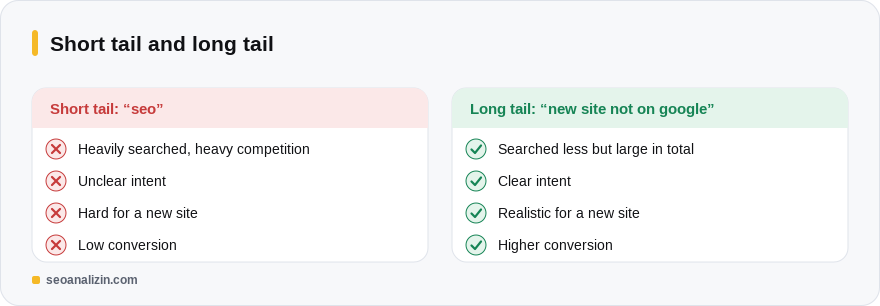
Why long-tail?
- Low competition: big sites are strong on general words; on specific questions new sites can rank too.
- Clear intent: someone typing “how to add canonical tag” knows what they want. See search intent.
- Better conversion: a page that solves a specific problem works harder than a general one.
- A path to growth: traffic from many small queries accumulates and adds authority to the site.
Where to find long-tail queries
- Search Console: in the Performance report, look at queries where you already get impressions but rank low (11–30). They are ready-made opportunities. See the Search Console guide.
- Google autocomplete: type a topic and note the suggestion list and suggestions added letter by letter.
- “People also ask”: turn the question boxes on the results page into questions.
- Bottom of the results page: the “related searches” section shows query variations.
- Your own customers: support questions, emails and comments contain real phrasing.
- A keyword tool: see the Keyword Explorer guide.
Which long-tail to choose?
- Ones your site can really answer well.
- Queries where weak or old pages show up in the results.
- Instead of a single query, gather queries sharing the same intent on one page: the same page can rank for several variations.
When writing
- Place the main query naturally in the title and first sentence. See title writing.
- Build subheadings with related query variations. See heading hierarchy.
- Give the answer first, then the detail.
To track the rank of the words you chose over time, see the rank tracking guide.
Example: from a query pool to a page plan
In Search Console these queries get impressions: “how to add canonical tag,” “canonical tag wordpress,” “wrong canonical what happens.” All three share the same intent: an implementation question about canonicals. Instead of three separate posts, write one comprehensive guide with sections split across these three questions.
After publishing, follow clicks and average position for the same queries; if position moves from 11–20 toward the first page, strengthen the title and the first paragraph.
Long-tail questions
How many words should a long-tail keyword be?
There is no fixed limit; generally three or more words, phrases with a distinct intent.
Should I not target general words?
You can, but on a new site starting with the long tail is more realistic.
Should I write a separate page for each variation?
No. Variations sharing the same intent should be handled on one page; otherwise duplicate content results.



Join the discussion
Share your experience or ask a question about this guide.