



Search intent is what a user really wants when typing a query. Google ranks results by that intent: someone typing “what is seo” wants an explanation, someone typing “buy seo tool” wants a product. If your page does not match the intent, it will struggle to rank no matter how good the content is.
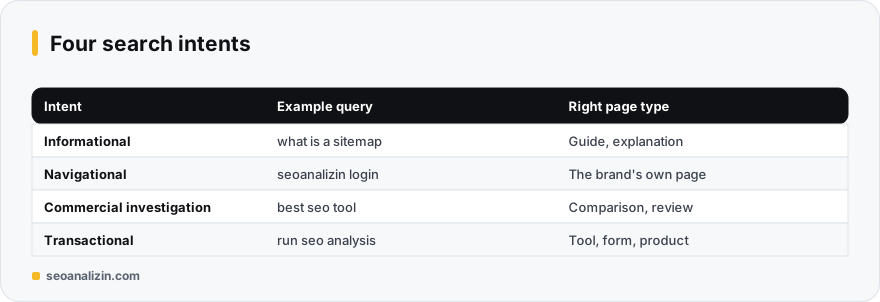
Four core types
- Informational intent: wants to learn. “what is a sitemap,” “how to add canonical.” Answer: a guide, an explanation, a how-to.
- Navigational intent: wants to go to a specific site or page. “seoanalizin login,” “search console.” Answer: that site itself.
- Commercial investigation intent: wants to compare before buying. “best seo tool,” “yoast vs rank math.” Answer: a comparison, review or list.
- Transactional intent: wants to take an action. “run seo analysis,” “create account,” “buy.” Answer: a tool, form or product page.
How to determine intent
- Search the query on Google and look at the top results: what types of pages are they? Lists, guides, products or tools?
- Note the features that show up: “People also ask,” video, a shopping box and a local map signal intent.
- Read the signal words in the query: “what is,” “how to” are informational; “best,” “comparison” are commercial investigation; “buy,” “price,” “free tool” lean transactional.
- A query can have more than one intent. Pick the dominant one.
Building content for the intent
- Informational: the answer in the first sentence, then explanation and an example. See the GEO guide.
- Commercial investigation: criteria, pros and cons, a recommendation. See comparing two sites.
- Transactional: a single clear call to action; no unnecessarily long text.
- Navigational: make the brand page clear and quick to reach.
A common mistake
Writing a sales page for an informational query or a long article for a transactional query. Google will not show it, because the user does not find the type they expected. When planning a post, determine the query's intent first. To choose which queries to target, see the long-tail keywords guide.
Example: the same topic, three different pages
On the topic of “sitemap,” three queries want three different pages: an explanatory guide for “what is a sitemap,” a comparison for “best sitemap generator” and a directly working tool for “create sitemap.” Trying to satisfy all three on one page weakens most of them.
So build your topic map by intent: one page for each intent, with clear internal links between the pages. The reader moves naturally from one page to another.
Search intent questions
How does intent affect rankings?
Google shows the page type best suited to the user. A page that mismatches the intent can fall back even if well written.
Can one page satisfy more than one intent?
Yes, but focus on the dominant intent. For example a guide can end by pointing to a tool.
Does intent change over time?
Yes. So recheck the results page now and then.



Join the discussion
Share your experience or ask a question about this guide.