



Search is no longer just ten blue links: in Google, AI Overviews, chat-based assistants and answer engines can produce a direct answer to a question and show sources beneath it. This new field is called GEO (Generative Engine Optimization) or AEO (Answer Engine Optimization). An honest starting point: Google says that appearing in AI summaries needs no separate special markup or file; good SEO and genuinely helpful content apply.
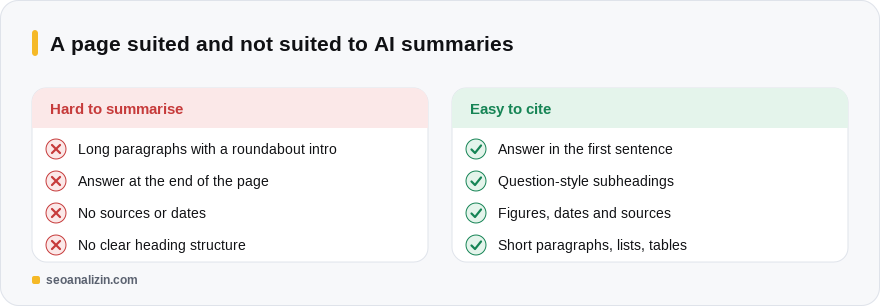
What changed and what did not
- Unchanged: a crawlable, indexable, fast and trustworthy site; relevant, original content.
- Changed: it matters more that content can be split into parts and summarised: clear answers, open structure, cited sources.
- Changed: visibility sometimes happens as a “citation” without a click; being named is also a gain.
What you can do to prepare your page
- Give the answer first. Put the answer in the first 1–2 sentences, then the detail.
- Use question-style subheadings and give a short, clear answer under each.
- Clear structure: short paragraphs, lists, tables. See heading hierarchy.
- Verifiable information: add figures, dates and sources; avoid vague generalisations.
- Trust signals: author, date, organisation information. See E-E-A-T.
- Technical foundation: the page must be crawlable; do not block bot access. See robots.txt.
Is llms.txt necessary?
llms.txt is a community-proposed file format meant to introduce a site to AI systems. Google has not stated it as a requirement, and its effect on rankings or inclusion in AI summaries is not proven. You may prepare one with the llms.txt Generator; but treat it as a low-cost experiment, not a guarantee.
Measuring your readiness
- The AI/GEO/AEO Analysis checks whether your page is ready for AI summaries.
- The Chrome extension shows SEO and AI/GEO readiness per page as you browse.
- For structured data status, see the schema guide.
A realistic expectation
No one can guarantee that a page will appear in an AI summary. The right approach is to make the page clear, sourced and trustworthy for both people and machines; this investment pays off in classic rankings too.
Before and after: rewriting a paragraph
Before: “Many site owners hear confusing information about robots.txt and so struggle to understand what the file is for. In fact, robots.txt is a file that gives bots some instructions about the site.”
After: “robots.txt is a plain-text file that tells search bots which parts of your site not to crawl. It does not remove a page from the index; that takes noindex.”
The second version gives the answer in the first sentence, carries a single idea and can be quoted. This rewrite helps both readers and the systems that summarise.
Realistic answers on GEO
Do I need a special tag to get into an AI summary?
According to Google, no. Standard SEO and helpful content apply.
Do AI summaries reduce traffic?
For some queries clicks may fall. Being named and high-quality clicks still matter.
Should I write separate content for GEO?
No. Strengthening existing content to be clear, sourced and question-and-answer shaped is enough.



Join the discussion
Share your experience or ask a question about this guide.