



E-E-A-T stands for Experience, Expertise, Authoritativeness and Trustworthiness. It is a framework used in Google's quality rater guidelines. It is not a single score or a direct ranking factor; Google's ranking systems aim to reward helpful, reliable content, and E-E-A-T is a way of describing that goal. Of the four letters, trust is the most central.
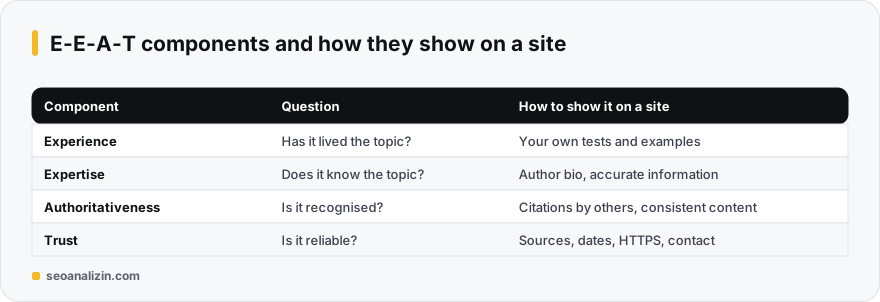
The four components
- Experience: has the person who wrote the content really lived the topic? Have they used the product or done the job?
- Expertise: was it written by someone who knows the subject and explains it correctly?
- Authoritativeness: are the site and author known on the topic and cited by others?
- Trust: is the information accurate, sourced, secure and transparent?
Where it matters especially
On topics that affect people's decisions or lives, such as health, finance, law and safety (“YMYL”), the quality bar is higher. In these areas the author's competence and the citing of sources are much more decisive.
Trust signals you can apply on your site
- Author information: name, short bio and area of expertise. Link posts to an author page.
- About and contact: state clearly who you are and how to reach you.
- Sources and dates: support claims with sources and show the publish and update dates.
- Real experience: add your own test, screenshot or example; do not repeat generic information.
- A secure site: HTTPS, a clear privacy policy and, in e-commerce, return and delivery terms. See the HTTPS guide.
- Corrections and updates: update old information and correct mistakes you find.
Does structured data help?
Article and Organization markup helps machines read author, organization and date information, but it does not create trust by itself. See schema markup. Visible information on the page always comes first.
Common E-E-A-T mistakes
- A fake author profile or an invented expert title.
- AI-generated, unsourced, superficial content.
- Comparisons that look neutral but are written under sales pressure.
- Hiding who is responsible.
Similar signals matter for being chosen as a reliable source in AI summaries too: see the GEO guide.
E-E-A-T check questions for a post
- Who wrote this post and why are they trustworthy on this topic? Is there an author box or bio?
- Are the claims in the post backed by sources?
- When was the post published and when was it last updated?
- Does the post include an example, test or image from your own experience?
- If a reader has a problem, how will they reach you?
If you cannot answer three of the five clearly, the post conveys information but does not build trust.
E-E-A-T, clarified
Is E-E-A-T a ranking factor?
Not a single factor or score. It is a framework for evaluating quality and relates to many signals.
Can a small site have authority?
Yes. Depth on a narrow topic, real experience and consistency build authority.
Is content without an author a problem?
Not required for every piece, but for information-heavy content an author and sources raise trust noticeably.



Join the discussion
Share your experience or ask a question about this guide.