



Search trends show how people's interest in a topic changes over time. Read correctly, they tell you which topic is rising, which is seasonal and when you should prepare content. Read wrongly, a number mistaken for an exact search count leads to bad decisions.
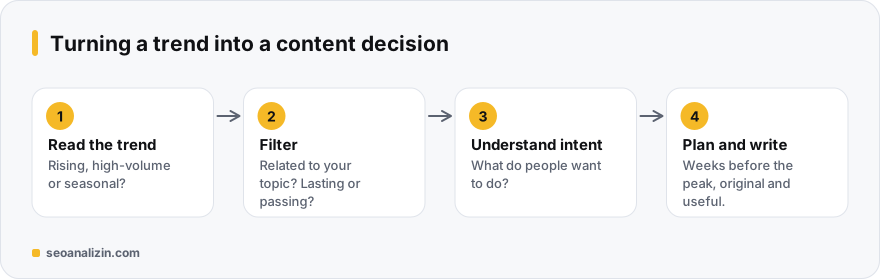
What does trend data show?
- Relative interest: Google Trends values are scaled from 0 to 100; 100 marks the highest interest in the chosen period. It is not an exact search count.
- Rising searches: topics growing quickly in a short time. It can be an opportunity or a passing news item.
- High-volume searches: heavily searched topics shown with approximate threshold values.
- Region and time: the same word behaves differently in another country and period.
Where in SEOANALİZİN?
The Turkey Search Trends page lists current Google Trends-based trends: rising searches and topics reaching high volume. The search volume shown is an approximate value; do not read it as an exact total.
Turning a trend into a content opportunity
- Distinguish: is it a lasting need (e.g. “what is a sitemap”), seasonal (tax, holidays) or a passing story (news, an event)?
- Ask about relevance to your site: chasing an irrelevant trend brings short-lived, low-quality traffic.
- Write fast but original: on a passing trend, not the first to publish but the one giving the most useful answer stands out.
- Plan seasonality ahead: publish 6–8 weeks before the peak so Google can discover and rank it.
- Combine with evergreen content: link the trend to a lasting guide. See the internal linking guide.
Traps
- Assuming a rising word is high-volume: there can be large percentage jumps from a small base.
- Looking at a single word: compare synonyms and different spellings.
- Separating the trend from search intent: what do people want to do? See search intent.
To track the rank of your own keywords, see rank tracking, and to find more lasting targets, the long-tail keywords guide.
Example: a calendar for a seasonal topic
An accounting site sees searches for “tax return” rise in certain months every year. Build the plan backwards: publish the guide 6–8 weeks before the peak, update it a month before the peak, and during the peak look in Search Console at which sub-queries are rising and add answers to the new questions.
When the season ends, do not delete the page; update it and keep it ready for next year. The same address benefits from accumulated signals every year.
Trend data questions
Is trend data an exact search count?
No. It is relative interest and approximate threshold values.
Should I write content for every trend?
No. Only for those related to your site's topic where you can give a genuinely useful answer.
When should I publish for a seasonal topic?
Weeks before the peak; Google needs time to discover and rank it.



Join the discussion
Share your experience or ask a question about this guide.