



Competitor analysis means understanding what sites competing with you for the same searches do well. The goal is not to copy them but to see gaps and opportunities: topics they cover that you do not, pages where you can answer better and their technical weaknesses.
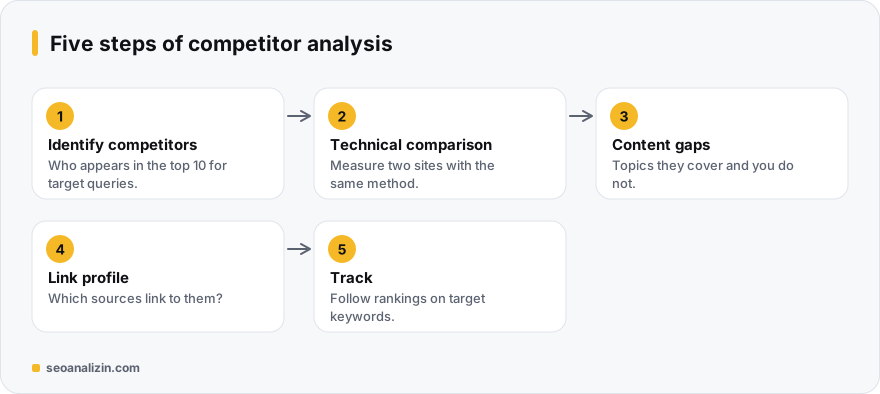
1. Identify your real competitors
Your business competitor and your search competitor may not be the same. Search your target queries on Google and list the sites in the top 10; sites that appear for the same queries as you are your search competitors. The list may include big brands and blogs; compare page by page for both.
2. Compare technical status
Run the competitor's home page and an important content page through the SEO Analysis; to see two sites side by side with the same method, use the Site Comparison. See comparing two sites.
3. Find content gaps
- Look at the competitor's blog or category structure: what topics do they cover?
- Note topics missing or weak on your site.
- See how the competitor's page answers the intent in the results page. See search intent.
- Find questions their answer leaves incomplete: a chance for a deeper, more current or more practical answer.
4. Review the link profile
See which sites link to the competitor with the Backlink Checker. The aim is not to get the same links but to understand which kinds of sources show interest: industry directories, blogs, news. For the kind of profile to aim for, see the anchor text and toxic backlink posts.
5. Track rankings
Regularly check your rank and the competitor's for your target keywords: the Google Rank Checker shows a domain's position for a chosen keyword, country and language. For detailed methods see the rank tracking guide.
Prioritising opportunities
- Quick: if your page already ranks but trails the competitor, improve it.
- Medium: new content for topics the competitor covers and you do not.
- Long term: authority and link acquisition.
For how to present your findings to a client or team, see the SEO report template.
Example: finding a content gap
Open the competitor pages holding the top three ranks for your target query and write their headings side by side. If all three have a “price” section and yours does not, that is a content gap. Likewise if all three have a table or current data and yours does not, that is what users expect.
When closing the gap, do not copy the competitor; offer something that sets the page apart, such as an example from your own experience or more current data.
Competitor analysis questions
Should I copy a competitor's content?
No. Write a better, more current and original answer.
How many competitors should I analyse?
Three to five real search competitors are enough.
Can I see a competitor's traffic?
Only the site owner sees exact traffic data. Figures from outside tools are estimates.



Join the discussion
Share your experience or ask a question about this guide.