



A good SEO report is not a pile of data but a decision document. A client or manager should be able to find answers to “what happened, why, and what do we do now?” on one page. The structure below is arranged to suit both technical and non-technical readers.
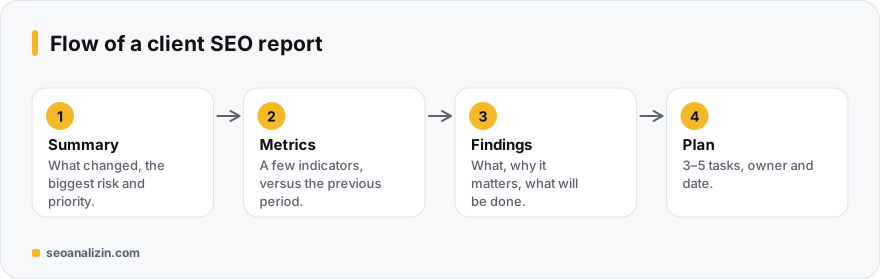
1. Executive summary (at the top, 5–6 lines)
- What changed in the period: for example clicks, impressions or pages in the index.
- The most important finding and the most important risk.
- A one-sentence priority for the next period.
2. Metrics
Choose a small number of meaningful indicators. For each add a comparison with the previous period and a short comment.
- Search Console: clicks, impressions, average position, indexed pages.
- Analytics: organic sessions and conversions.
- Technical status: SEO Analysis score and number of critical issues.
- Rank of key keywords: see rank tracking.
3. Findings
Write each finding in three parts: what (with evidence), why it matters and what will be done. Instead of “title tag missing,” write “37 pages repeat the title; pages look alike in results; each page will get a unique title.”
4. Prioritisation
Mark each action by impact and effort. Do high impact, low effort work first:
- Urgent: things that block indexing (noindex, robots, 404).
- Important: on-page fixes and content updates.
- Planned: new content, link acquisition, performance projects.
5. Next period plan
Three to five clear tasks, with an owner and a target date. The report should also say what the next report will measure.
Template
1. Summary (5–6 lines)
2. Metrics (vs previous period)
3. Findings: what / why it matters / what will be done
4. Priority table: impact x effort
5. Next period: task, owner, date
6. Appendix: detailed technical list
Common reporting mistakes
- Pages of screenshots and charts without commentary.
- Promising rankings: nobody can guarantee rankings.
- Not turning a finding into an action.
- Showing all issues with the same weight.
For issue detection you can start the basic analysis with the 10-minute check; to understand what the score means while reading the report, see the SEO score post.
A report sentence example
A weak report sentence: “Organic traffic grew.” A strong one: “Organic clicks rose 18% in the last 28 days; most of the rise came from two new guides. The third guide is not yet indexed, and an internal link will be added for it.” The second says what happened, why and the next step.
Put the points the client must decide on (budget, priority, approval) at the very top of the report; keep the detail in the appendix.
Questions when preparing a report
How often should a report be prepared?
Monthly suits most projects; every two weeks during technical work.
How many pages should a report be?
A one-page summary with details as an appendix. Decision makers do not read long text.
What do I write if results have not come?
Write the situation, the reason and the plan honestly. Delay is normal in SEO, but it should not go unexplained.



Join the discussion
Share your experience or ask a question about this guide.