



“Toxic backlink” is not an official Google term but an expression used by tool vendors: links from sites that look spammy, irrelevant or manipulative. The key fact is this: Google already ignores most odd and spammy links. So panicking and disavowing every suspicious link is often unnecessary.
Which links are really a problem?
- Links that were bought or swapped, created only for rankings.
- Low-quality directories and link farms unrelated to your site.
- Links arriving in bulk from sites with gambling, adult or pharma content.
- Hundreds of links with the same anchor text arriving in a short time.
- An attack or negative-SEO attempt you did not make.
Spotting suspicious links
- In Search Console's Links report, look at the sites linking to you and the anchor texts.
- List your link profile with the Backlink Checker and flag strange sources.
- See whether there is a sudden jump in the number of new links.
- Check whether suspicious sources are really sites a human would read.
For a way to tell whether a link is good or weak, see the backlink quality analysis.
When do you need to do something?
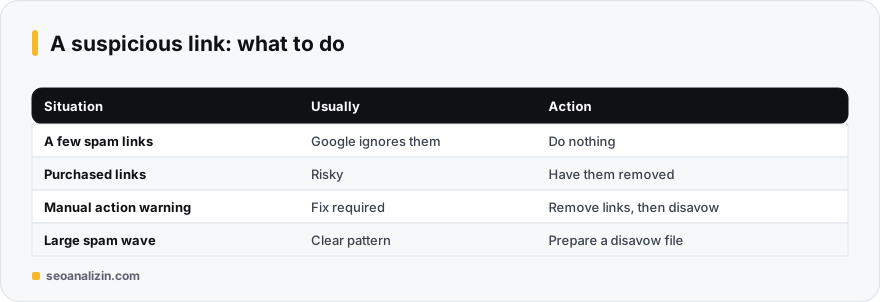
- In most cases nothing: Google already does not count them.
- If you bought them: have the links removed if possible.
- If you got a manual action: if Search Console shows an “unnatural links” warning under “Manual actions,” you must fix it.
- If there is a large, clear spam wave: consider the disavow tool.
How does disavow work?
Google's Disavow tool asks Google to leave the links or domains you list out of consideration. It is an advanced tool; wrong use can remove good links too. First try to have the link removed; if that fails, prepare a text file like this:
# problem domains
domain:spamsite.example
domain:linkfarm.example
# a single address
https://bad.example/page.html
The real solution
More valuable than cleaning bad links is earning good ones: useful content, being mentioned in the right places and brand awareness. For link types see dofollow and nofollow, and for text variety the anchor text post.
Example: 500 links overnight
A site's link report suddenly shows 500 new links, all with the same anchor, from unrelated foreign-language sites. The first step is not to panic: these are probably spam links Google already ignores. What to do: check whether Search Console shows a manual action warning, check whether there is a real drop in traffic or rankings and monitor the profile for a few weeks.
Prepare a disavow file only if there is clear damage or a manual action.
Short answers on spam links
Do spam links lower my rankings?
In most cases no; Google ignores them. Buying manipulative links is risky, however.
Should I disavow every suspicious link?
No. Only if there is a clear spam pattern or a manual action.
Can a competitor send me spam links?
It is possible but the effect is limited; Google generally ignores such links.



Join the discussion
Share your experience or ask a question about this guide.