


“Dofollow” is actually not a tag but the name of the default state. If you give a link no special rel attribute, Google treats it as a normal link and allows page signals to pass to the target. So there is no rel="dofollow" value in HTML. What you actually manage are links you do not want followed.
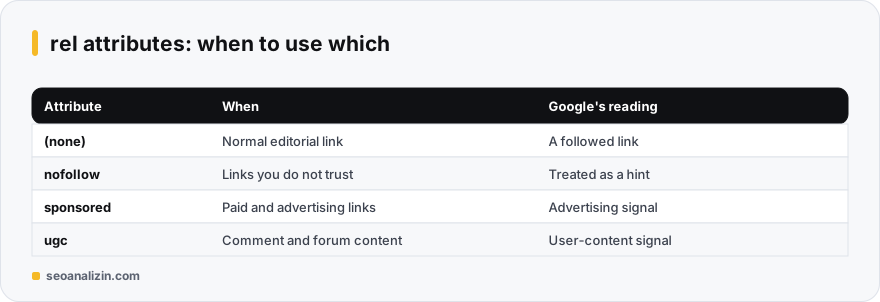
Three attributes
- nofollow: the general signal meaning “I do not trust this link or cannot vouch for it.”
- sponsored: for advertising, sponsorship or paid placement.
- ugc: for user-generated content such as comments, forums and user profiles.
<a href="https://example.com" rel="nofollow">Link</a>
<a href="https://example.com" rel="sponsored">Ad</a>
<a href="https://example.com" rel="ugc">Comment</a>
<a href="https://example.com" rel="sponsored nofollow">Together</a>
How does Google treat these attributes?
Since March 2020, nofollow, sponsored and ugc are hints to Google, not strict commands. Google uses them as a signal for both ranking and crawling. So do not assume nofollow shuts the signal off completely.
When to use which
- A normal editorial link: no attribute is needed. Link freely to sources you trust.
- A link you were paid for or got something in return for:
sponsoredis required. An unmarked paid link violates Google's guidelines. - Comments and forums:
ugcornofollow. Most CMSs do this automatically. - A source you do not trust:
nofollow.
Link attribute mistakes
- Putting nofollow on your own internal links: it needlessly restricts the flow of page strength. See the internal linking guide.
- Not marking paid placement.
- Putting nofollow on all external sources and giving no useful links.
Checking link attributes
The Backlink Checker helps you see the attributes of links pointing to your site. You can review the outgoing links on your own site in bulk with the Site Crawler. For bad links, see the toxic backlink post, and for link text the anchor text guide.
Example: a link decision in a blog post
Your post has three external links: one to an official document, one to a partner company's paid article, one to an address in a reader comment. The right marking: an unmarked (normal) link to the official document; rel="sponsored" for the paid placement; rel="ugc" for the address in the comment. Each honestly describes the nature of the link.
If you are unsure about a link, ask: am I giving this link only because it helps the reader, without getting anything in return? If the answer is yes, it can be left unmarked.
Short answers on link attributes
Is a nofollow link useless?
No. It can bring traffic and is part of a natural link profile.
How do I get a dofollow link?
There is no special markup: an unmarked link is followed by default. What matters is earning the link.
Should I give dofollow links to external sources from my site?
Yes, to sources you trust that benefit the reader.



Join the discussion
Share your experience or ask a question about this guide.