



Duplicate content is the same or very similar text on more than one address. Contrary to a common belief, Google usually resolves it not with a penalty but with filtering: it picks one of the similar pages and hides the others. The problem is that the chosen version may not be the one you want, and your signals get split.
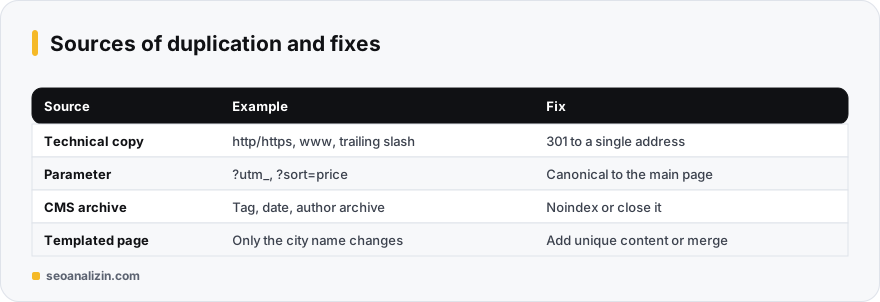
Where duplication comes from
- Technical copies: http/https, www/non-www, trailing-slash and no-slash addresses.
- Parameters:
?utm_, sorting, filters and session IDs. - CMS archives: category, tag, date and author archives list the same posts.
- Templated pages: hundreds of near-identical pages where only a city or product name changes.
- Copied content: manufacturer descriptions or text taken from another site.
Ways to find copies
- Search a sentence in quotes on Google:
"the exact copied sentence". If the same text appears on other addresses, similar pages exist. - In Search Console's Pages report, look at statuses starting with “Duplicate”: they show how Google resolved canonical selection.
- Group pages with the same title, description or content summary in the Site Crawler.
- Verify which address the suspect pages prefer with the Canonical Checker.
Fix methods
- 301 redirect: an old or unnecessary copy should permanently go to the main address. See 301 vs 302.
- Canonical tag: pages that must exist but serve the same content (parameter addresses) should point to the main page.
- Noindex: for pages users need but that should stay out of search.
- Differentiate or merge: templated pages must carry real, unique information on every address. Otherwise merge them.
<link rel="canonical" href="https://www.example.com/product/shoes/">A canonical is a hint, not a command: if Google sees conflicting signals, it makes its own choice. So keep internal links, the sitemap and redirects consistently pointing to the same address. For details see the canonical guide.
When should you worry?
When an important page is missing from the index or the wrong version ranks. It is normal for a parameter address not to be indexed. If hundreds of templated pages fall into “crawled, currently not indexed,” the value of the content is being questioned: see this guide.
Example: parameterised product addresses
/shoes/, /shoes/?sort=price and /shoes/?color=black list the same products. The right setup: all three addresses use /shoes/ as the canonical; internal links and the sitemap contain only the clean address. Where filter pages have separate value in search (for example there is real search demand for “black shoes”), you can write a unique title and content for that filter and leave it as its own page.
Short answers on duplicate content
Does duplicate content cause a penalty?
Copied, manipulative content carries penalty risk. Technical duplicates lead to filtering, not penalties.
How many similar pages is too many?
There is no fixed ratio. If two pages give the same answer to the same question, consider merging them.
Can I quote another site?
Short quotes with attribution are fine. Copying large parts adds no value.



Join the discussion
Share your experience or ask a question about this guide.