

Imagine a product available at both /products/desk/ and /products/desk/?color=oak. Search engines must decide whether these URLs represent distinct pages or variants of the same content. A canonical tag signals which URL you prefer as the representative version. It is not an absolute instruction: Google may select another URL after evaluating the pages and other available signals.
What does rel=canonical actually do?
The markup <link rel="canonical" href="https://example.com/products/desk/"> belongs in the document head. It helps manage duplicate or near-duplicate content that can appear through sorting parameters, print layouts, or multiple URL formats. It should not be used to combine unrelated pages merely because you want one of them to rank more strongly.
Worked example: filters and sorting
Suppose /chairs/ lists all chairs, while /chairs/?sort=price changes only ordering. A canonical pointing from the sorted view to the main category may reflect the relationship well. But a filtered “office chairs” page with unique products and its own search demand could deserve an independent URL. Evaluate substantive content differences and user intent before applying a universal canonical rule to all parameters.
HTTPS, www and trailing-slash consistency
If the live site uses https://www.example.com/ while canonical tags point to http://example.com/, the signals conflict. Choose one preferred address format. Align navigation links, permanent redirects, sitemaps, and canonical annotations. Update internal links to the final URL rather than unnecessarily sending visitors through redirect chains.
Canonical and hreflang on multilingual sites
Genuine English and Turkish versions usually need canonical tags pointing to their own language URLs. Setting the English page’s canonical to the Turkish page can undermine the intent to index both language versions. Hreflang expresses language relationships; canonical deals with representative URLs. They cooperate but they do not perform the same job.
Four canonical mistakes worth checking
- Broken target: The declared URL returns 404 or 5xx.
- Redirecting target: Canonical points to a URL that immediately redirects elsewhere.
- Template bug: Every article or product declares the home page canonical.
- Conflicting signals: Sitemap suggests one URL while canonical recommends another.
These errors are not automatic penalties, but they can make crawling, reporting and URL selection less predictable.
Practical canonical audit checklist
- Request the page and check its final HTTP status.
- Inspect canonical markup in the rendered head; avoid conflicting duplicates.
- Confirm the destination is accessible and substantially equivalent.
- Align preferred URLs in the XML sitemap.
- Compare declared and Google-selected canonical URLs in Search Console.
Review a URL using Canonical Checker and related directives with the Indexability Checker. Use the Site Crawler for broader patterns.
Canonical versus redirects and noindex
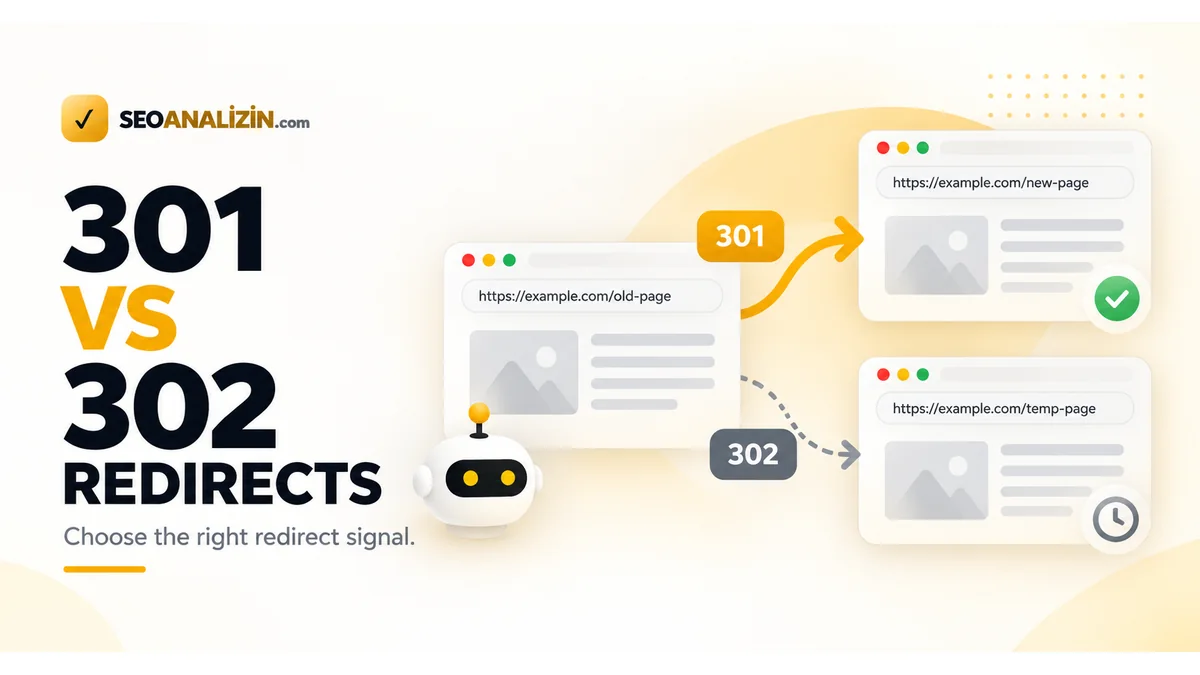
If content has moved permanently, start with the 301 versus 302 guide. When multiple similar URLs need to remain accessible, canonical may be useful. When a page should not appear in search at all, revisit the robots.txt versus noindex guide. Choose tools according to the underlying problem rather than applying every directive everywhere.
Frequently asked questions
Should a page canonicalize to itself?
A self-referencing canonical can clarify the preferred URL, but does not guarantee indexing.
Can Google ignore the declared canonical?
Yes. Content, redirects and other signals may lead to a different selection.
Will canonical improve rankings?
Not automatically. Its principal role is consistent management of duplicate and preferred URLs.
References: Google canonicalization and consolidating duplicate URLs.


Join the discussion
Share your experience or ask a question about this guide.