



Hreflang is a hint that tells Google about the different language or region versions of a page. The goal is to show Turkish searchers the Turkish version and English searchers the English one. It does not make a translation rank higher; it makes sure the right version is served to the right audience.
Four core rules
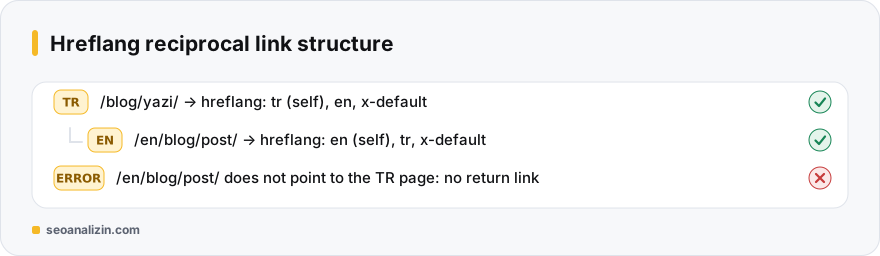
- It must be reciprocal: the TR page must point to the EN page and the EN page back to the TR page. Markup without a return link can be ignored.
- It must point to itself: each page must include its own address in the hreflang list.
- Correct codes: ISO 639-1 for language (
tr,en), ISO 3166-1 for an optional region (en-GB,en-US).en-UKis wrong. - Full, canonical addresses: do not use addresses that redirect, are noindex or return 404.
Example: the Turkish page
<link rel="alternate" hreflang="tr" href="https://example.com/blog/yazi/">
<link rel="alternate" hreflang="en" href="https://example.com/en/blog/post/">
<link rel="alternate" hreflang="x-default" href="https://example.com/en/blog/post/">
The same three lines must appear on the English page too. x-default names the default version for users who match no language; it is not required but recommended.
Three ways to implement it
- HTML head: the most common method, as above.
- HTTP header: for non-HTML files such as PDFs.
- Sitemap: suited to central management across many pages.
Choose one and use it consistently; different values at the same time create conflicts.
Validating hreflang
- Produce the correct tag set with the Hreflang Generator.
- Verify reciprocal links and codes with the Hreflang Checker.
- Make sure the canonical points to itself in every language version; see the canonical guide.
Hreflang mistakes
- Missing reciprocal link.
- Pointing all languages to a single canonical: this neutralises hreflang.
- Automatic browser-language redirects: Googlebot usually sees one language. Offer users a choice.
- Wrong language and region code.
A checklist for a Turkish–English site
- Does every Turkish page have an English counterpart? If not, leave only its own tag on that page.
- Are the three lines (tr, en, x-default) identical on both versions?
- Does each version's canonical point to itself?
- Does the language switcher offer visitors a choice, or does it redirect automatically?
- Are both language versions in the sitemap?
Verify all five on a few sample pages with the Hreflang Checker, then roll out to the whole site.
Where hreflang trips people up
Is hreflang required on every translated page?
Yes, if the page has a counterpart. Do not add a reference to a page that has none.
Does hreflang raise rankings?
No. It helps the right language version be served.
Is it needed for different countries in the same language?
It helps when price, currency or content differs (for example en-US and en-GB).



Join the discussion
Share your experience or ask a question about this guide.